Sandbox MMO
Pixel Worlds: MMO Sandbox
This knowledge base covers Pixel Worlds: MMO Sandbox — a free-to-play, multiplatform sandbox MMO where you build your own island, gather and craft, farm and breed, and trade with other players in a shared, continuously rebuilt universe. There are no fixed character classes here; your identity is what you build, craft and how you run your economy. Rules and numbers throughout are the game's own, and wherever a value is live (shop prices, event rewards, world resets) the page says to check in-game.
These are the game's own systems and rules — not a live read. Shop prices, seasonal events and which worlds are up right now change, so check in-game for the current state.
The game in one minute
What Pixel Worlds is, at a glance
A 2D, free-to-play sandbox MMO you can play across phones, tablets and PC/Mac — build, gather, craft, breed and trade in a shared universe that gets reset so nobody starts with an unfair head start.
Pixel Worlds is a sandbox MMO rather than a class game. You don't pick a warrior or a mage; you start on your own island and shape everything by hand — breaking blocks for materials, planting and crossbreeding trees, wiring together circuits, collecting pets, and opening your build to other players. The whole universe is rebuilt periodically so the long-term players don't lock the newcomers out, which is what makes the economy and the player-built creations the heart of the game.
The shared universe
How the shared, rebuilt world works
One online universe everyone plays in, with player-built worlds others can visit, and periodic fresh starts that wipe the field so new players can catch up.
The game is built around a single shared online universe. Each player gets their own island or plot to develop, and the worlds you build are open — other players can visit, trade with you, or drop into your creations. What makes the MMO part work is the regular rebuilding of the universe: the world gets reset so that no single veteran group can permanently hoard the best land or the rarest resources, and the player-driven economy starts fairly for everyone each time.
Because the reset is a core design choice rather than a bug, the things that matter most across resets are what you keep learning and the relationships and market positions you rebuild. The fresh start is what turns this from a lone sandbox into a shared MMO experience.
The systems that make up play
What you do with a plot
Building and creating on your island
The whole point of a sandbox: place blocks, grow things, wire circuits and shape the island into whatever you want — a farm, a parkour course, a shop, a mini-game.
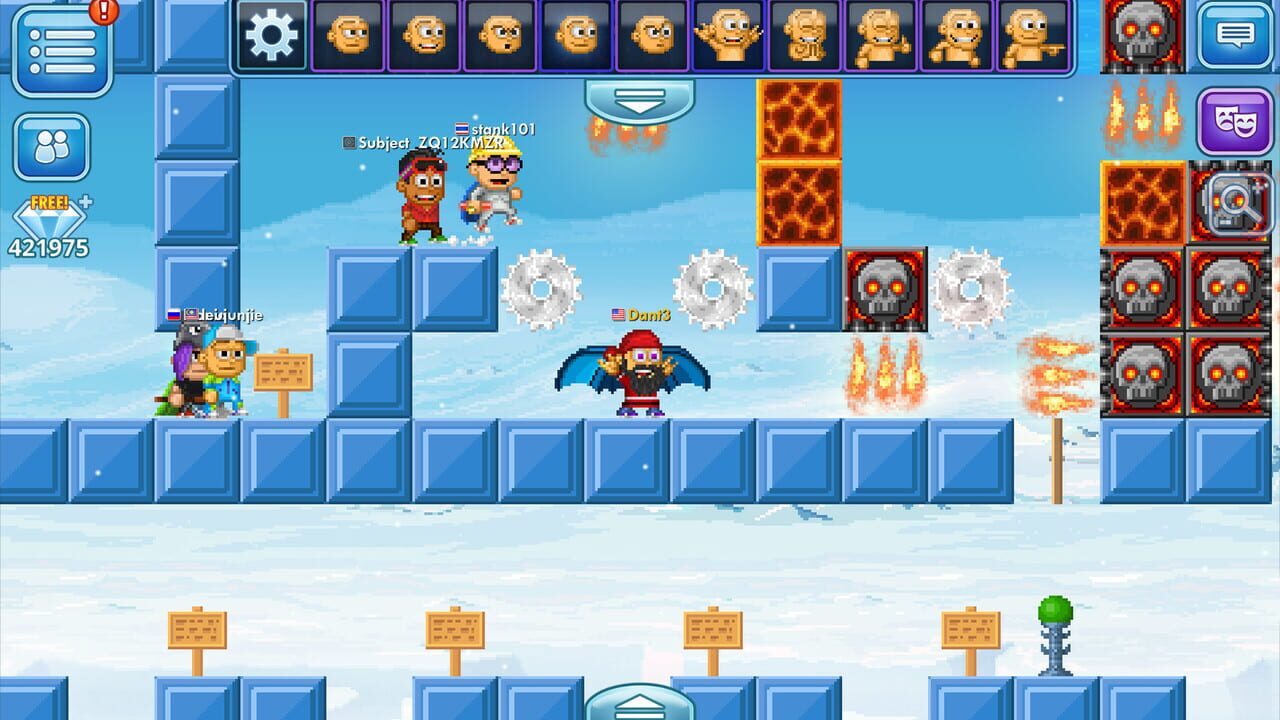
You build with blocks you have gathered or crafted. A plot is blank until you decide what it is — a steady farm, a display of pixel art, a trading hub, a parkour course or an adventure map others can run. Movement, jumping and the basic 'punch' to break blocks are your starting tools; the wrench and the quick-access slots are how you place things and reach what you last used.
Wiring is its own layer: the game has a wiring tool and circuits you can lay down, which is what lets builds go beyond static scenery into machines and interactive rooms. The four zoom levels are there so you can work on a single block or back out and read the whole island at once.
Getting and growing things
Farming, gathering and the recipe system
Farming is how you get a steady supply of a block instead of running out, and the recipe book is how new things unlock over time.
Gathering is the supply side. Break a block and you can get the block back, its seeds, and gems plus occasional special drops; planting a seed makes a tree that grows and can be harvested again for more blocks. That loop is what 'farming' means in the game — a block you can keep regenerating instead of one-off. Crossbreeding two compatible seeds by planting one over the other can change the resulting tree into something new.
The recipe book is where new ideas unlock as you play. Everything you can make is listed there, so when you're stuck on how to get something you open the book and follow the recipe back to the blocks you actually need to gather.
→ The pet side of collection, its own loop→The player-driven economy
Gems, Byte Coins and trading with players
Two currencies run the loop: gems, the premium one, and Byte Coins, the earned one — and most of what makes this an MMO is that players trade with each other.
The shop is where the two currencies meet. Gems are the premium currency you can buy or earn, and they buy Byte Coins and items; Byte Coins are the everyday currency you use for what players and the game sell you. Because the world resets but the social layer stays, experienced players set up their own shops and hubs, and the price of something can be set by the players selling it as much as by the game.
That is the 'player-driven economy' part of the name in practice: the game provides the currency and the meeting place, and the players decide what things are worth by what they actually list and trade.
Loading news...
All gates passed. {"evidence_count":12,"validation_errors":[],"verdict_via":"editorial-local"}