MMORPG
Albion Online
Cross-platform MMORPG with player-driven economy and full-loot PvP.
Open the Knowledge Base — the game's own numbers in plain EnglishThis knowledge base compiles the numbers and systems that matter for Albion Online — the gear-tier scale that replaces levels as the source of power, the role model (there are no classes here, only kits you build around weapons), the player-driven economy where cities, refining and crafting set every price, and the PvPvE loop that ties world bosses, raids and open-world fights to your silver. Every figure is the game's own. Where the reference is thin — live market prices, current boss spawns, per-kit balance — it says so instead of guessing. Nothing here is live data, so anything 'current' (market prices, drop rates, boss timers) is something you'd check in-game.
These are the game's own rules and constants — not live server data. For current market prices, boss spawns or kit balance, check in-game.
The game in one minute
What Albion Online is, at a glance
A full-sandbox MMO where you choose a role, not a class: your power comes entirely from the gear you carry, and the whole economy — from a single ore to a finished T8 item — is made and bought by players.
Albion Online is a full-sandbox MMORPG. There are no classes and no levels that make you stronger — the moment you pick up a weapon you have picked a kit, and your strength is whatever tier and enchant that gear carries. Everything in the world is player-made: a smith refines ore in a city, a crafter forges the bar into gear, a trader ships it to a market. The only things that touch your power are the items you own, so the economy and combat are the same system. PvP, PvE and the player market are all one continuous loop, and dying in a red zone can cost you the very gear that defines you.
The role model, not classes
Three roles, chosen by what you wear
Because there are no classes, a 'role' is just the kit a set of weapons and armor turns you into. The game sorts combat into Tank, Damage and Master/Support.
| Role | Typical kit | Job in a fight |
|---|---|---|
| Tank / Cavalier | Shield + heavy plate, a one-handed weapon | Hold the frontline, soak or deny damage, kite with a mount |
| Damage (DPS) | Ranged staff, bow or spear — or a melee damage kit | Focus and kill the target; ranged variants hold space, melee variants dive |
| Master / Support | Holy or cloth kit, an orb or tome offhand | Heal the group, purge debuffs, and often double as a damage source |
The same weapon can be a different role depending on the armor and offhand around it — a staff with cloth is a caster, the same staff behind a shield and plate is a different job. That is why the Build Advisor reasons from your gear and role together rather than from a class. Pick the role that fits the content: solo world bosses lean on a durable mixed kit, guild ZvZ leans on a defined frontline plus ranged damage and a healer, and open-world solo play rewards the cheap, mobile, fast-to-replace builds.
The roles, in one click each
How gear value is measured
The tier and enchant scale
Every item has a tier (T2 to T8) and an enchant within that tier (.0 to .4). Together they set item power, and item power is the single number the whole economy prices against.
| Tier | Name | Where you meet it |
|---|---|---|
| T2 – T4 | Novice's → Adept's | Starter and early-game zones; cheap to replace, fast to outgrow |
| T5 – T6 | Expert's → Champion's | Midgame power; the range where you start running named bosses and real PvP |
| T7 – T8 | Mythic's → Sovereign's | Endgame; the target for serious groups and serious bankrolls |
An item's power is built from a base of 300, plus 100 for each tier above base, plus 100 for each enchant step. A T8.4 therefore reads far higher than a T4.0, and that gap is the whole ladder. Raising value is a craft, not a level: you buy a base item, reroll its quality, then upgrade it with runes, souls and relics to lift the enchant, and the market prices each step against the next tier. The Build Advisor and Refining Profit tools both run on these same tier/enchant numbers.
The full tier reference lives on its own wiki page→Read any item's exact power in the Build Advisor→The player-made economy
Cities, refining and the crafting chain
Almost nothing is priced by the game itself. Players gather the raw, refine it in a city for a bonus, craft it into gear, and sell it in the market — that chain is the economy.
The cities and their specialty
- Lymhurst — leather, wood and stone refine here at the city bonus
- Fort Sterling — metal and iron, the heavy-mining city
- Velesta — food, hide and wood, the frontier agricultural city
- Thetford — food, leather and hide, the farming and tanning hub
- Caerleon — metal and wood, the western textile market
- Martlock — the all-rounder: food, wood, leather, metal and stone
- Brumas — food and hide, the last agricultural city
Each city pays a flat +15% specialty bonus on the resource it refines, so a crafter moves to the city that matches the input to make every refinement and craft cheaper in the same spot. The refining step turns raw gathering into bars, planks and other buildable parts; the crafting step turns those parts into the tiered gear a fighter buys. Guilds — or the cheaper 'collective' version — add a second, larger bonus on top of the city's, which is why endgame crafters join a group rather than working solo in a city. The Refining Profit tool ranks each city's ore-to-bar margin, so you can see where the silver actually lands.
How a guild or collective raises the crafting bonus→See city-by-city refining margins in the Refining Profit tool→PvP and player-vs-everything
Zones, world bosses and raids
The world is split into zones that change the rules: where you can be attacked, where you fight other players, and where the big shared threats live.
| Zone | What it is | Gear stakes |
|---|---|---|
| Blue / green | Safe PvPvE — you only fight neutral mobs and crafted spawns | Low; you aren't fighting other players here |
| Yellow | Player attacks allowed, at the risk of losing what you carry | Medium; you choose to engage, you choose to lose |
| Red | Full open PvP — anyone can be attacked and dropped at any time | High; this is where tiered gear actually means something |
| Black | Hostile world — everything is a threat and the loot is the best | Maximum; built for coordinated groups |
On top of zone PvP sit the big shared encounters. Fixed and roaming world bosses respawn on a roughly two-hour cycle, are guarded by elites, and are built for a party of about ten — the classic fight is a group of mixed roles that kills the boss, cleans the loot and defends it from rival groups (ZvP). Raids are the heavier, more choreographed version of that. ZvZ — group versus group — is the same power ladder turned into organized warfare over territory and the market routes it protects. Because everything is player-made, a boss kill is also a market event: it puts fresh high-tier gear into circulation and re-prices what everyone is selling.
The encounters, on their own pages
Starting from zero
What a new character actually does
You spawn with no gear, no level advantage and no class — just a kit you can upgrade as fast as you can afford it, and three ways to earn the silver to do that.
How a starter earns silver
- Gather a resource with a basic tool, refine it in the nearest city, and sell the bar — the cleanest first-income loop
- Craft simple early items (food, potions, low-tier gear) and list them on the market while they are still cheap
- Run the early safe zones and dailies for steady drops and chest rewards, keeping a fast, replaceable kit on the cheap side
The early game is deliberately a ladder of tiers you climb: T2 to T4 gear keeps you alive in green zones, and each rung is reachable from the one below by either crafting up or buying one tier up on the market. There is no level gate holding you back, so 'progression' really means 'a better item.' Keep your starter kit cheap and mobile so a loss in a yellow zone is cheap to recover from, and let a gathering-and-crafting side income build the bankroll that funds the first real tier jump. The goal at every step is the same: trade silver for a higher tier, because the tier is the power.
Why levels don't make you stronger here→The gather-refine-craft loop in detail→The game's own numbers, in plain English — start from the Knowledge Base →
 Editorial
Albion Online Beginner Guide 2026: How to Start
New to Albion Online? No classes, no levels, you build your own. Here's the first-hour flow, the alchemy of gear, and how to make your first gold.
 Editorial
Albion Hallowfall Healer Build: Crystal Arena 2026
Play Hallowfall Staff healer in Albion Crystal Arena: gear, Mistcaller off-hand, combos, positioning, energy and matchups.
 Editorial
Albion Online Mists Guide 2026: Solo Builds & Profit
Master Albion Mists in 2026: solo T8-T9 black-zone builds, survival tactics, escape routes and real silver per run.
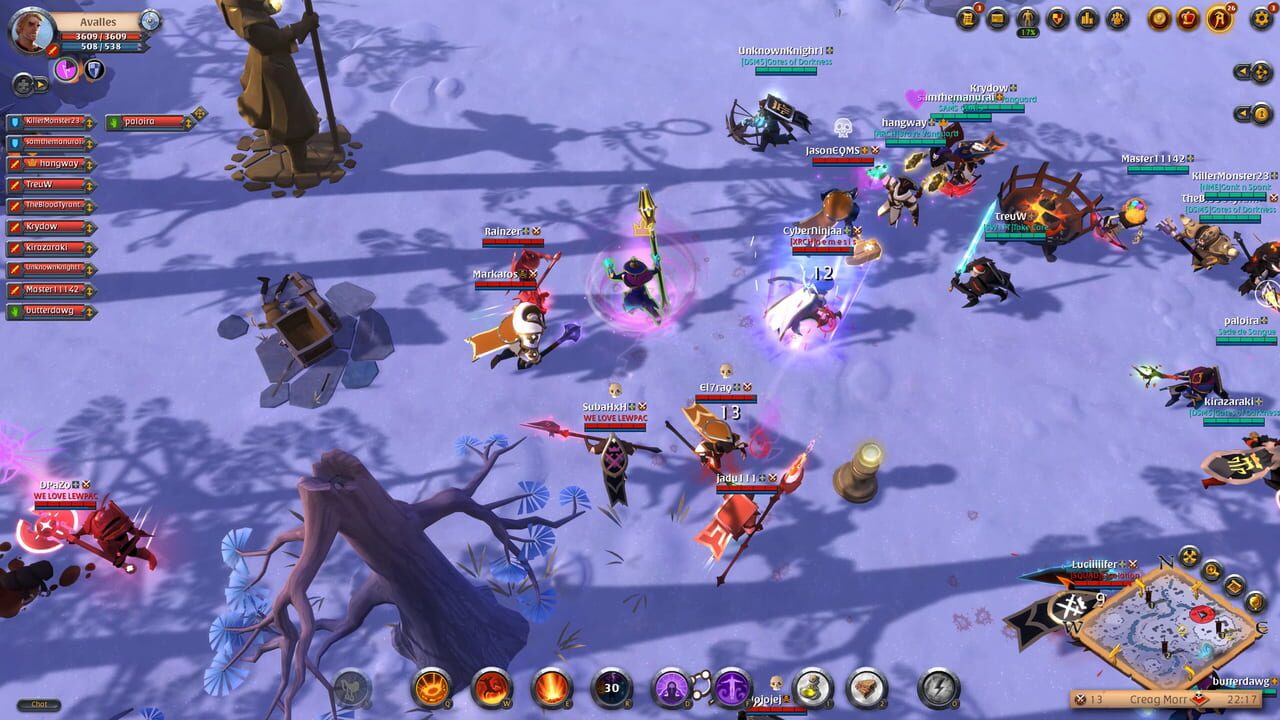 Editorial
How ZvZ Works in Albion Online: Territory, Castle Sieges & Season Points
Guild warfare in Albion Online: ZvZ roles and composition, territory control, castle sieges, and how to earn season points — a practical 2026 guide.
 Editorial
Albion Bloodletter Solo Gank Build: Mistcity (2026)
Bloodletter solo ganking in Albion Mistcity: T7 loadout, consumables, skill rotation and 1v1 execution tips for 2026.
 Editorial
Albion Online Solo PvE Farming Build (2026)
Best Albion solo PvE fame-farming builds for blue/yellow zones and Mists: budget to premium gear, routes and tips.
Loading news...
Free Tools — Albion Online
Calculators, checkers and planners for Albion Online — free, no login. The rules behind every one live in the Knowledge Base →
Albion Online is a massively multiplayer online role-playing game developed by Sandbox Interactive. The game features a player-driven economy, full-loot PvP, and cross-platform play.