Indie MMORPG
Adventure Land - The Code MMORPG
This knowledge base covers Adventure Land — The Code MMORPG, an experimental open-source indie MMO whose defining twist is that a player writes JavaScript to drive up to four characters, so the code does the grinding while you do something else. It covers how the CODE system works, the Korean-style upgrade and crafting loop, the fully player-to-player economy, and the daily dungeon and PVP loop. Every rule here is the game's own. Where something is live — the current player count, a market price, what the latest update shipped — the page says to check in-game rather than guess.
These are the game's own rules and systems — not a live read of the servers. Population, market prices and the current update are live data. Check in-game.
The game in one minute
What Adventure Land is, at a glance
An open-source indie MMO where you script up to four characters in JavaScript and let the code grind — a non-pay-to-win game with a fully player-run economy.
Adventure Land is an experimental indie MMO, built open source. The loop is: you attach a CODE — a piece of JavaScript — to each of your characters, and that CODE runs the hunting and the busywork for you, which means up to four characters can grind on their own while you are away from the keyboard. You can still play by hand; the code is a tool, not a requirement. The game is deliberately non-pay-to-win, there are no seasonal wipes, and the economy runs entirely between players: keep a merchant open around the clock and sell or buy with other people.
The CODE system
How the JavaScript automation works
Each character carries a CODE that takes over the grinding, and the characters can talk to one another through the game.
The whole design hangs on one idea: your character is driven by a CODE you write. You start with a working CODE and learn as you go, and a player can run up to four characters at once, each with its own code. The CODE does the repeated work — the farming and the routine fights — so progression continues without you holding the keys. The four characters are not independent: they can communicate with one another, which is how you coordinate a small party of your own scripts instead of one. Writing the code is a skill track of its own: a player who can script better grinds better.
→ The CODE system, its own page→→ The four-character rule and the communication between them→Upgrading & crafting
The upgrade loop, and the crafting it feeds
A Korean-style upgrade mechanic sits at the center: push a weapon up with success-or-failure risk, then combine accessories and craft around it.
The progression mechanic is an upgrade one: you upgrade your weapons and gear, and like the Korean upgrade tradition it carries risk — the attempt can fail. That risk is what the loop prices out for you: how much you push, and what it costs, is the real skill. Around the weapon loop sits the crafting side. You combine accessories and craft items, and you farm gold to buy and sell, so the upgrade loop and the economy loop are the same loop seen from two angles. What any item is worth, and what an upgrade just did to yours, is live data.
→ The upgrade mechanic, its own page→→ The economy that turns that loop into gold→Economy
A fully player-to-player economy
There is no shop to the sky: the economy is peer to peer, and a player's open merchant is how goods move.
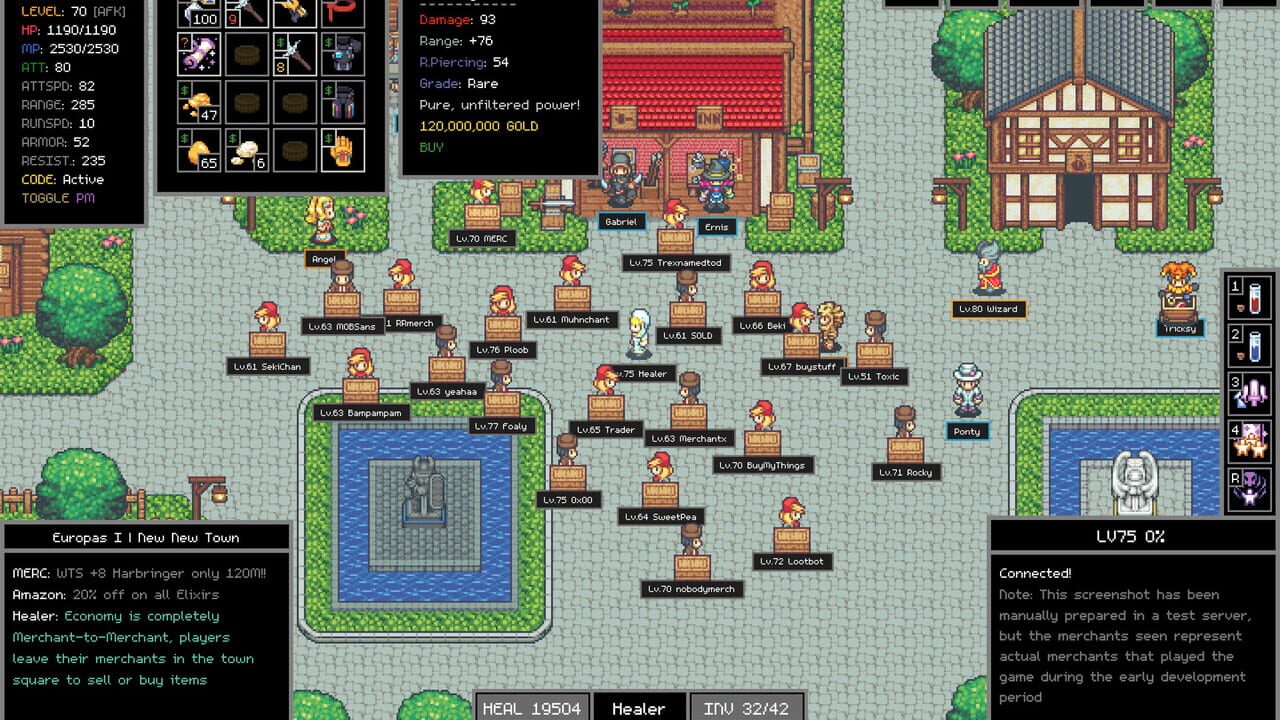
The economy is completely peer to peer. There is no central vendor that is the only source of anything; instead you keep your own merchant open, available around the clock, and sell to and buy from other players. Gold is the currency — you farm it, and the PVP maps are where LUCK, GOLD and XP are all turned up, so the riskier maps pay out more. Because the whole economy is player-run, what anything is priced at is a live, market-shaped number rather than a fixed value the game sets.
Activities & long-term play
What a player does long-term
The daily dungeon, the PVP loop and the growing party are the standing goals — progression does not reset.
There is a daily dungeon to clear, rare loot to hunt, and the PVP maps where the increased LUCK, GOLD and XP come from. Because the game has no seasonal wipes, your party keeps growing and nothing is reset when a season ends — the long game is the accumulating one. Guilds and daily events are on the roadmap, shaped by the community, so the endgame takes its shape from what the player base asks for. What is live in-game right now is checked in-game.
→ The daily dungeon→→ The PVP maps and the LUCK/GOLD/XP trade→Current state
Live, open source, community-shaped
The game is live on Steam and Mac, open source, and still being shaped by its player base.
Adventure Land is live on Steam and on Mac. It is open source — you can read the code, learn from it, or contribute to it — and the developer's stated direction is that the game is shaped by community feedback. The update the players see right now, the current online count and the current state of the live features are all live data, not part of this reference.
Loading news...
All gates passed. {"evidence_count":12,"validation_errors":[],"verdict_via":"editorial-local"}