Card Game
Hearthstone
Digital card game set in the Warcraft universe. Standard and Wild formats, Battlegrounds auto-battler mode, and regular expansions. Active since Mar 2014.
Open the Knowledge Base — the game's own numbers in plain EnglishThis knowledge base covers what a player actually needs to know about Hearthstone — the ten classes and what each one is built to do, the card and deck rules underneath every match, and the formats you can play: ranked Standard and Wild, the Arena, Tavern Brawls and Duels. The ten classes and the rule structure are the game's own. The meta — which decks are winning this week, which set is live — turns over with every release, and this reference says check in-game for that.
The classes, formats and card rules are the game's own. The live meta, the current set rotation and ranked rewards are live data — check in-game.
The game in one minute
What Hearthstone is, at a glance
A digital collectible card game built around ten classes, a 30-card deck and a card-per-turn rhythm — you out-grind, out-surge or out-attack the opponent to zero their hero before they zero yours.
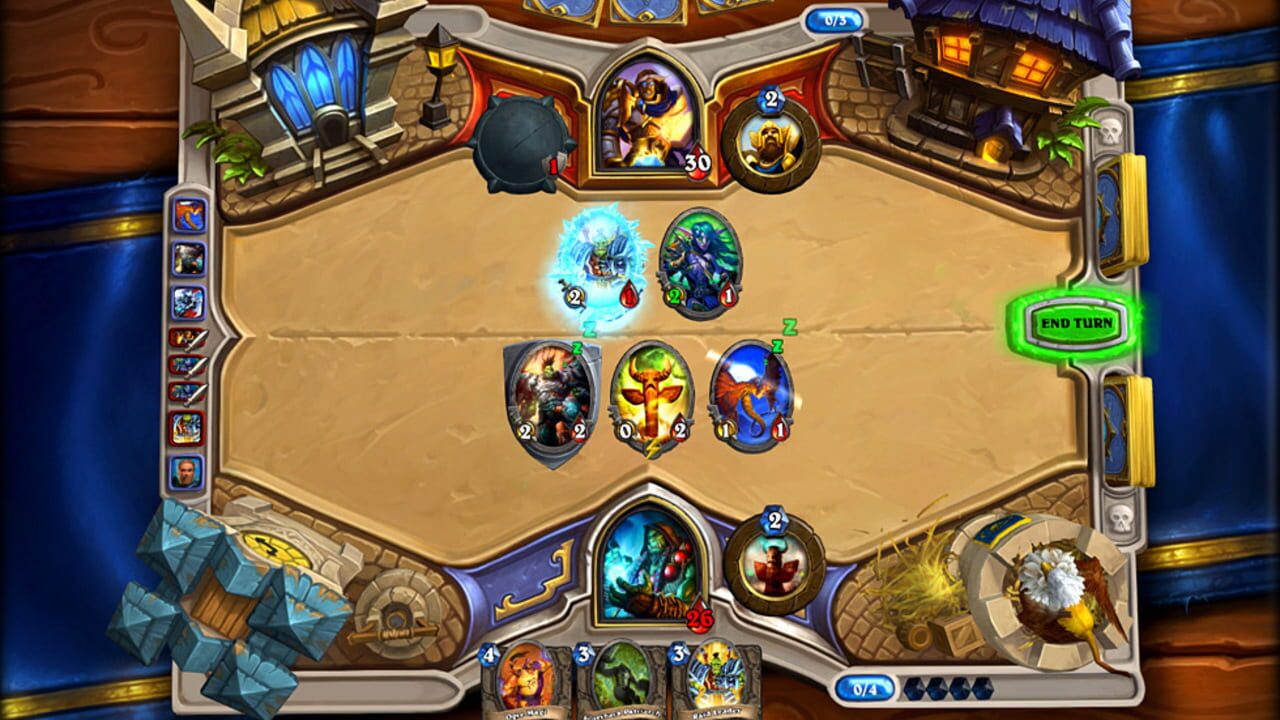
Hearthstone is a digital card game where two players take turns playing cards from a 30-card deck, each leading a hero — one of the ten classes — with 30 health. The second player gets a free Mana Crystal each turn and a fourth starting card; from there it is the same rhythm for both: one card per turn, the mana curve rising each round, and the match ends when one hero hits zero. The class is the deck's identity: which card types it has access to, what its hero power does, and how it plans to win.
The ten classes
What each class is built to do
Every deck belongs to one of ten classes, and each one has its own win condition, tempo and card pool — the roster the whole game is built around.
| Class | What it's built to do |
|---|---|
| Warrior | Aggressive face pressure and weapon-based trades; beat them down before they recover |
| Paladin | Token generation and buff stacking; a steady grind that snowballs late |
| Hunter | Tempo and board control through traps and tokens; strong early, strong mid |
| Rogue | Backline board tricks: combo damage, card draw, misdirection; plans the win in advance |
| Priest | Midrange value and healing; trades the board patiently for a late-game advantage |
| Mage | Direct spell damage and burst; the fastest win conditions in the game |
| Warlock | Aggressive value — early curve, big plays, and a late-game burn-off to finish |
| Druid | Flexible midrange: ramp, tokens, big threats; adapts to what the opponent shows |
| Shaman | Charge attacks, totems and board presence; steady tempo with burst on top |
| Demon Hunter | Tempo and board control with demon synergy; strong midgame pressure |
The ten classes are the spine of the game: you build every deck around one of them, and the class decides what you can do. Some are built to rush — Warrior, Hunter, Warlock lean on early pressure to finish fast. Others are built to outlast — Paladin, Priest and Druid win by playing better in the late game. Mage and Rogue plan a specific kill: a burst or a combo that is set up over several turns. Shaman and Demon Hunter sit between the two, mixing tempo with spikes of burst.
Each class, on its own page
The formats
Ranked, Arena, Brawls and Duels
Four ways to play a match, each with its own economy: ranked climbs a ladder, the Arena is a bought best-of-three, Tavern Brawls run on house rules, and Duels are fast custom rules.
Ranked play is the ladder: Standard and Wild each run from Bronze to Legend, and your wins move you up. The Arena is a single-entry best-of-three: you buy the run, build a deck out of randomized picks, and climb the win ladder for gold — a run can lose after the fourth loss, and the ladder decides how far you go. Tavern Brawls and Duels are the off-meta formats: recurring special rules and fast custom modes that shake up what a deck can be.
The four formats
- Ranked Standard — the ladder on the current set rotation
- Ranked Wild — the ladder on every card ever released
- Arena — a bought best-of-three with a win ladder
- Tavern Brawls & Duels — recurring and fast custom-rule formats
Cards & deck rules
The rules underneath every match
A 30-card deck, two copies of any card, mana that rises one crystal a turn, and card types that do different jobs — the rule layer the whole game runs on.
A deck is 30 cards, and you can include two copies of any single card — that is the whole build limit. Cards come in rarities, from common through legendary, and the rarity is what makes a deck a build project. In play, each turn the game adds a Mana Crystal, so early turns are cheap cards and late turns are the big plays: the curve of a deck is the shape of its mana spending. Heroes have a power you can use in place of a card, and every class's power is the card-type it favors.
| Rule | What it is |
|---|---|
| Deck size | 30 cards, up to two copies of any card |
| Mana curve | One more Mana Crystal each turn; turns grow |
| Hero power | The class power, usable in place of a card each turn |
| Rarities | Common through legendary — the deck's build tiers |
| Second player | Extra starting card, plus a free coin each turn |
The game's own numbers, in plain English — start from the Knowledge Base →
🔄 Updated this fortnight
Loading news...
Digital card game set in the Warcraft universe. Standard and Wild formats, Battlegrounds auto-battler mode, and regular expansions. Active since Mar 2014.