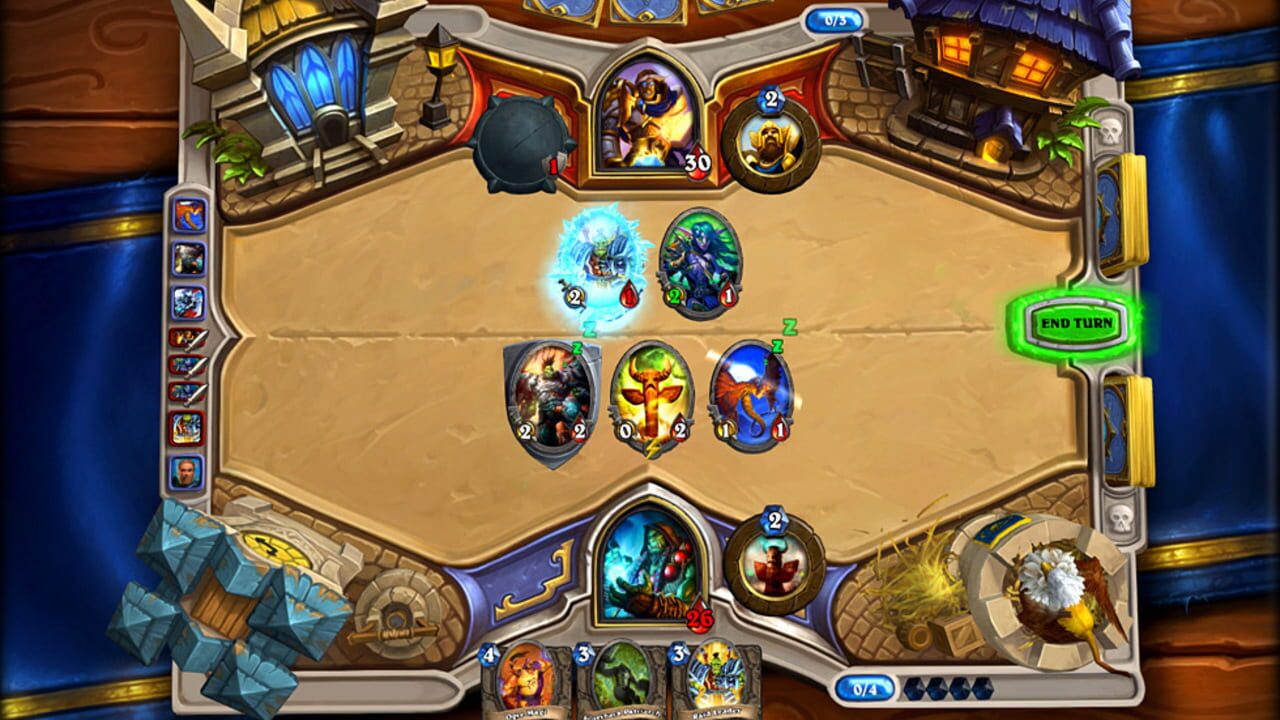
Hearthstone is Blizzard’s digital card game where every match is a 20-40 minute battle of strategy, resource management, and reading your opponent. It is free to play, and the free tools alone are enough to reach a respectable rank. This guide walks you through your first few weeks: what to do before you open the app, how to build your first deck, and how to earn gold without spending money.
Note: Hearthstone is in constant flux. Card lists, class identities, and the current meta rotate with every set. The strategies below are evergreen, but check the in-game shop and the official site for what is meta this month.
Before you play: know the three pillars
- Cards are currency. Every win and quest earns gold. Gold is used to craft new cards and unlock classes. Plan every gold spend.
- The ladder is a skill race. Ranks reset every season. You climb by playing well against other players, not by hoarding cards.
- Free is not weak. Blizzard’s free deck builder and the free card pool cover every class. You do not need to buy anything to win.
Your first week: pick one class and learn its identity
Do not try to learn all 12 classes at once. Each class has a distinct role:
- Warrior — aggressive, high-attack minions, armor as a resource.
- Mage — burst damage and removal spells, a low-health engine.
- Priest — late-game scaling, healing, and hand manipulation.
- Rogue — combo-based, low damage, high burst windows.
- Druid — shapeshifting, ramp, and long-term value.
- Shaman — fast aggression and elemental tools.
- Paladin — steady tempo, battlecries, and protective armor.
- Hunter — aggressive, no armor, high tempo.
- Warlock — burn spells, life gain, and high-damage removal.
- Death Knight — mid-tempo, deathrattle synergies, and lifesteal.
- Monk — aggressive combo engine, mana reduction.
- Barbarian — high-tempo aggression, armor synergy.
Pick the one whose playstyle you enjoy. Open the Deck Builder, use the free starter decks, and play 20 games. Do not worry about winning. Your goal is to learn the class’s core verbs: how it attacks, how it defends, and what it wins with.
Week 2: understand the golden rules
- One deck per class is enough. Do not spread your gold across five classes. Focus.
- Craft before you buy. Gold is always better than cards, because gold can become any card.
- Play the mulligan correctly. Mulligan = shuffle back unwanted early cards. For aggressive decks, keep 0-2 mana cards. For control, keep 1-3.
- Track the board state. Before you play, ask: “What does my opponent do next?” This single habit improves your win rate more than any card list.
Week 3: start the ladder
The ladder has 12 ranks, from Bronze 1 at the bottom to Legend at the top. New players start in Bronze and Silver.
- Do not chase rank early. The goal is to learn the match-up, not to hit Gold by day 21.
- Play your best class. If Warrior is your class, play Warrior. If your deck is weak, craft upgrades before the ladder, not during it.
- Watch replays of your losses. After a bad game, replay it. Most losses are 1-3 mistakes, not bad luck.
Week 4: build a craftable rotation
By day 30 you should have:
- A Craftable deck that you can rebuild from scratch using your gold.
- A backup deck for a different playstyle, in case the ladder rotates.
- A crafting plan: list the 10 most-valuable missing cards and prioritize them.
FAQ
Do I need to buy packs to progress?
No. You can win, craft, and unlock classes entirely for free. Buying packs only speeds up the process.
How many gold do I need to build a competitive deck?
A basic deck costs about 3,000-4,000 gold to craft. A competitive list runs 8,000-15,000. Plan for a month or two of gold savings.
Should I follow meta lists or build my own?
Follow the meta for the first two weeks. It teaches you what the community considers strong. After that, try to understand why a card is included, not just that it is.
Is Hearthstone still worth playing in 2026?
Yes. The game has a healthy player base, regular set rotations, and a free-to-play model. It is not a grind-heavy MMO, but it is one of the most polished competitive card games available.
Hearthstone: Deck Building Basics
The deck builder is where you convert your gold into a win. A few fundamentals that hold up across every set:
- A 30-card deck is the starting point. Do not pad to 35 just because you have the cards. The extra cards dilute the deck.
- Match the curve to the class. A deck that is all late-game cards does not win in the early turns, and a deck that is all early-game cards has nothing to do by turn 6. The curve is the shape of the deck, and it should match the class’s identity.
- One deck per class is enough. Do not spread your gold across five classes. Focus on the one class whose playstyle you enjoy, and build it hard. Check the in-game shop for the current class pool, because the set rotates with every season.
- Craft before you buy. Gold is always better than cards, because gold can become any card. If you are deciding between crafting a card and buying a pack, craft. The gold compounds.
Hearthstone: Daily Quests That Actually Pay Out
The daily quest is the main source of free gold, and the smart play is to optimize it:
- The daily quest is the most efficient gold source in the early game. The quest rewards are the baseline, and the weekly event content on top of that is the second tier. Complete the daily quest every day.
- Match the quest to your class. The daily quest is built around a specific class, and it is most efficient when you are playing that class. If the quest is for a class you have not built, it is still worth doing, but the gold compounds slower.
- The weekly event is the mid-tier gold source. The weekly event rewards are the main source of mid-game cash, and the seasonal events are the long-term wealth builder.
- The login bonuses are free gold. The most efficient use of your time in the early game, and the free gold that compounds with the daily and weekly.
The free-to-play model is complete: every meaningful piece of content is accessible without spending. Check the in-game shop for the current quest rotation.
How many cards should a competitive deck have?
Thirty. Do not pad to 35 just because you have the cards. The extra cards you add are the cards you do not need, and they dilute the deck. The curve is the shape of the deck, and it should match the class’s identity.
What is the best way to earn gold as a free player?
The daily quest, the weekly event, and the login bonuses, in that order. Complete the daily quest every day, the weekly event on top of that, and the login bonuses for the free gold. The free-to-play model is complete: every meaningful piece of content is accessible without spending.
Should I buy a starter pack?
No. The free deck builder and the free card pool cover every class, and the free-to-play model is designed to be fully playable. Buying a starter pack only speeds up the process, and the gold you save is better spent on crafting the cards you actually need.
Keep exploring
- Hearthstone on MMOKB — the Hearthstone game hub has the full knowledge base, tools and guides.
- Browse the full library — all MMOKB guides
Reviewed & verified
| Covers | Hearthstone |
| Last verified | November 24, 2026 |
| Accuracy | The game’s own numbers and rules — they change with patches; check in-game for live values. |
Discussion
0 commentsNo comments yet. Be the first!