Adventure MMO
Sea of Thieves
Open-world pirate adventure with ship combat, treasure hunting, and PvP. Crew up with friends and sail the seas. Active since Mar 2018.
Open the Knowledge Base — the game's own numbers in plain EnglishThis knowledge base covers Sea of Thieves — Rare's first-person pirate action-adventure where you sail a ship with a small crew, do the whole pirate job yourself (sailing, fighting, digging, cooking), and turn loot into reputation with the Merchant Alliance. It explains the core loop, the ships and crew roles, the siren and monster content, and the season model that keeps the game updating. Every rule and system here is the game's own; anything that moves — season rewards, event schedules, economy numbers — the page tells you to check in-game.
These are the game's own systems and rules — not live data. For the current season's rewards, event calendars and doubloon prices, check in-game.
The game in one minute
What Sea of Thieves is, at a glance
A first-person pirate sandbox where you and your crew of up to three do everything by hand — sailing, cannon-firing, digging up your own treasure, cooking and boarding — and sell it for fame and riches.
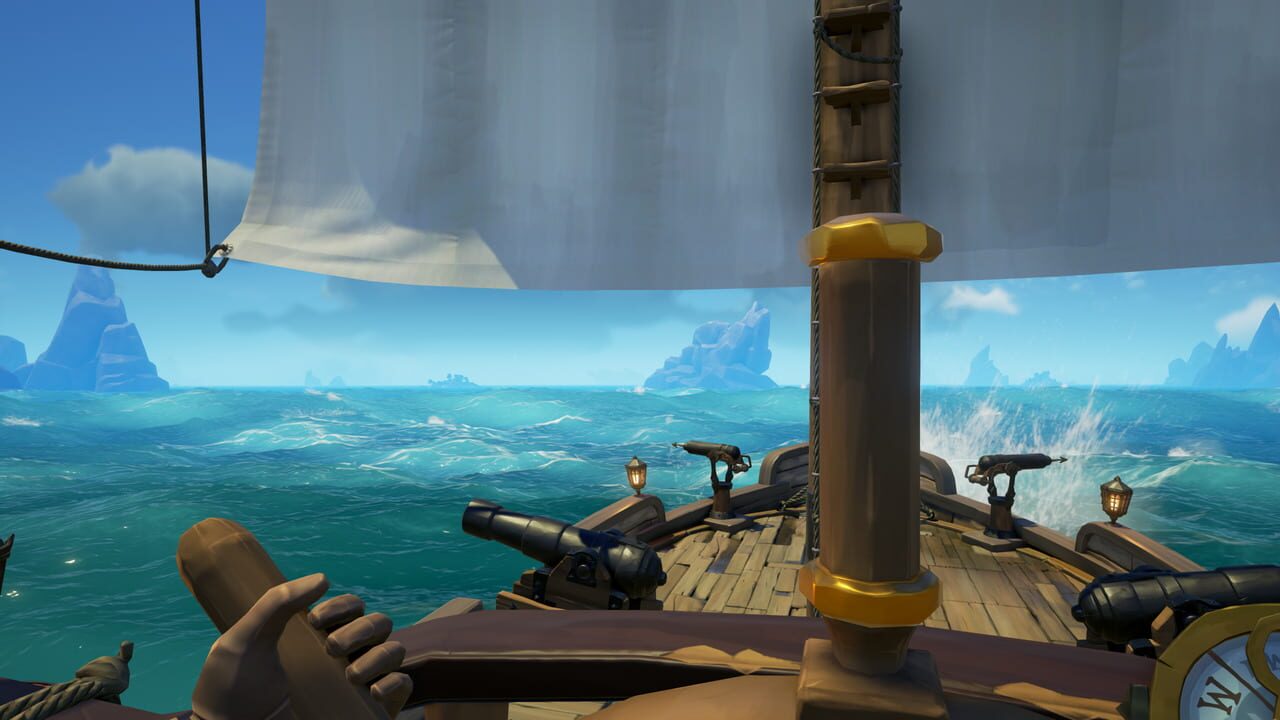
Sea of Thieves is not an MMO in the class sense — it is a shared open sea where small crews set out and do the whole pirate chain by hand. You sail a ship with your own crew, fight monsters and rival players, dig your own graves for treasure, and bring the haul home to the Merchant Alliance for gold, reputation and progression. The game runs on seasons: each one expands the world with new content and a calendar of themed and recurring live events, with a free season pass that pays out rewards as you level it up. Platforms are Xbox, Windows (Microsoft Store, Steam, Battle.net) and PlayStation 5, so a sea has mixed platforms in it.
The pirate loop
The loop: sail, looting, fighting, selling
One session is a chain of decisions: which island to hit, how to loot, who to fight on the way, and what to do with the haul when the ship is taking damage.
A session follows the pirate's own economy: you and your crew pick a target — an island dungeon, a siren's bounty, a camp, or another ship — sail it, do the work by hand (every board you climb, every chest you open, every plank you fix is a button on your part), and decide what to do with the loot. The tension is the ship itself: it takes damage, it can sink, and the moment your hull is going under your whole haul is at risk, so the loop constantly asks you to choose between grabbing more and making it home. Selling goes to the Merchant Alliance for gold, or to the other factions the game has built up as the loop matures — which you read in the game.
The loop, in its own order
- Pick a target — island, siren bounty, camp, rival ship
- Do the work by hand — loot, fight, board, fix the ship
- Decide when the haul is big enough to protect
- Get home and sell — gold, reputation, progression
The ships
Sloop, Brigantine and Galleon
Three ship classes, each a different trade-off between speed, crew, cargo and guns — and each one plays completely different.
| Ship | Crew | Play style |
|---|---|---|
| Sloop | Small crew (1-2 practical) | Fast, light, solo-crew friendly; gets out fast, fights light. |
| Brigantine | Medium crew (2-3) | The balance pick: real cargo, real guns, a crew that covers roles. |
| Galleon | Full crew (3-4) | Slow and heavy; the strongest guns and the biggest hold, and needs a full crew to run. |
Picking the ship is the first design decision of the session, because the ship is the ship: it carries the crew, the cargo and the guns, and its handling is a skill of its own. A sloop crew can out-run a fight; a galleon crew that is not coordinated will sail in circles. The ship is also the whole economy on the move — the moment it sinks, everything aboard is at risk — so the class you sail is the shape of your session.
→ The ships and the crew roles, on their own page→The sea's own dangers
Sirens, krakens and the other monsters of the sea
The sea is not empty: siren bounties, world monsters and the siren that calls you to a shipwreck all gate the best loot, and all of them are the game's own content.
The sea has its own threats, and they are the best loot gates the game has. Sirens issue bounties — the siren's reward for finishing what she called you to — and the bigger creatures: the world monsters and the siren that calls you to a wreck, are the game's version of a boss fight, with a loot pool that pays for the risk. The same water that hides the treasure is where the biggest things live, so the loop's real skill is reading the sea: knowing where to go and what is going to meet you on the way. The specific monster roster and their current values are the game's own content; the live versions move with seasons.
→ The monsters of the sea, on their own page→The season model
How the game updates: seasons and live events
Sea of Thieves runs on a season cycle: each season adds content and a calendar of themed, recurring live events, and a free season pass pays out as you climb it.
The game updates on seasons rather than on a single 1.0: each season adds new content, expands the world, and ships a calendar of themed and recurring live events — the sea changes with the season. The season pass is free and runs 50 levels: rewards unlock as you play the season's content, and the season's live events are where the calendar-driven content lands. What the current season is, what it added and when its events run is the game's own live data — the model is stable, the content rotates.
→ The season model and the live events, on their own page→The game's own numbers, in plain English — start from the Knowledge Base →
🔄 Updated this fortnight
Loading news...
Open-world pirate adventure with ship combat, treasure hunting, and PvP. Crew up with friends and sail the seas. Active since Mar 2018.