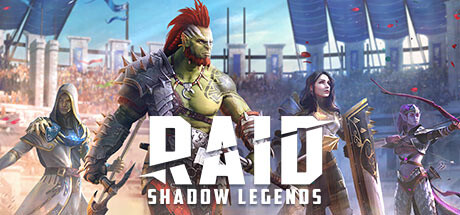
Gacha RPG
Raid: Shadow Legends
Turn-based gacha RPG with 700+ champions, campaign, dungeons, clan boss, and PvP arena. Active since Jul 2018.
Open the Knowledge Base — the game's own numbers in plain EnglishThis knowledge base compiles what a player actually needs to know about RAID: Shadow Legends — how champions are built and the roles a team of five is assembled from, the faction system that shapes which champions are worth keeping, the clan boss loop, and the endgame content set — in plain English. Everything here is the game's own structure. Where something is live — the current champion line-up, the event season, dungeon bosses — the page says to check in-game rather than guess. Nothing in this reference is a live read of the servers.
These are the game's own rules and structure — not live server data. For the current champion line-up, event rewards or dungeon state, check in-game.
The game in one minute
What RAID: Shadow Legends is, at a glance
A team-building fantasy RPG: you collect champions, group them into teams of five by role, and run the teams through boss content, dungeons and PVP.
RAID: Shadow Legends is a team-building fantasy RPG. Progression is not one character but a roster: you collect champions, each built to one of four roles, and field teams of five against the content. The loop runs on team composition — the roles have to cover the fight — on the gear and ascension those champions carry, and on the clan, which is where the endgame boss content lives. The counts above are the game's own structure, not a community estimate.
Champions & roles
The four roles a team of five is built from
Every champion lands in one of four roles, and a team is only as good as the way the five roles on it cover the fight.
The game sorts its champions into four roles: Attack, Defense, HP and Support. Attack champions deal the damage, Defense champions hold the line and bring the tank stats, HP champions soak, and Support champions heal, buff and control. A team of five is a set of five of these slots, and the content is built around the coverage: a dungeon boss that out-damages a team without the right HP and Defense slots will stop the team no matter how strong its attackers are. The roles are the team's skeleton; the gear and ascension on each champion is the tuning on top of it.
| Role | What it does in a team |
|---|---|
| Attack | Deals the damage the content expects. |
| Defense | Holds the line; the tank stats. |
| HP | Soaks damage; the wall in front of the team. |
| Support | Heals, buffs and controls. |
The faction system
Factions and why they shape the roster
Champions come from factions, and the faction is the lens the content is read through: some content is built around a faction's strengths.
Every champion the game ships belongs to a faction, and the faction is not just flavor: the content reads through it, because some of the harder fights are built to reward a faction's strengths and punish the team that does not have them. That makes the roster a question of coverage — which factions you can field a full team from — and the faction wars are where that coverage is tested head to head between players. The faction list and its strengths are the game's own; the current value of a faction in the live meta is the part this reference leaves to the in-game state.
→ The faction system, on its own page→The clan boss
The clan boss loop and its keys
The endgame shared boss content runs on the clan boss: three named bosses, a key-based cadence, and a difficulty ladder the clan climbs.
The clan boss is the shared endgame: three named Demon Lords, each one its own boss with its own mechanics, and each one offered on a difficulty ladder the clan moves up. The cadence is key-based: a player accrues a key on a fixed timer, and the keys are what let the team hit the boss — the timer and the cap are the game's own rules for how fast a clan can work the bosses. The difficulty rungs step up as the clan's damage climbs, and the top rungs are where the strongest teams are measured.
| Rule | What it is |
|---|---|
| The bosses | Three named Demon Lords, each its own fight. |
| The difficulty ladder | Five rungs, from the easiest to the hardest, climbed as the clan's damage climbs. |
| The keys | A fixed-timer accrual per player; the cadence the boss work runs on. |
| The cap | The keys accrue to a cap, not past it. |
Endgame content
The content set beyond the boss loop
Beyond the clan boss, the endgame runs on the dungeon bosses, the roguelike tower, the PVP modes and the limited-time fusions that are the main source of the new champions.
The endgame content set runs in parallel with the boss loop. The dungeon bosses are the per-content fights, each one with its own mechanics and its own team requirements. The roguelike tower is the solo grind where a team runs floors for the gear rewards. The PVP modes include the real-time arena and the faction-level PVP, which is where the faction coverage gets tested. And the limited-time fusions are the main source of the new champions the roster keeps growing — the fusions are timed, so the champion a player wants is often one the player has to catch inside its window.
The endgame, on its own pages
Where the game stands
The current state of the game
RAID: Shadow Legends is in active development with a regular season cadence; the live part is what the current season is adding and rewarding.
The game is developed on a season cycle, and each season adds the new champions, reworks the event line-up and reshapes which faction coverage the content rewards. The structure above — the roles, the faction system, the boss loop — is the stable part; what a player reads off the current season is the live roster, the current fusions and the current PVP state. That is the live half of the game, and it is the half this reference leaves to the in-game screens.
The game's own numbers, in plain English — start from the Knowledge Base →
No guides yet. Write the first!
Loading news...
Turn-based gacha RPG with 700+ champions, campaign, dungeons, clan boss, and PvP arena. Active since Jul 2018.