
Side-scrolling MMORPG
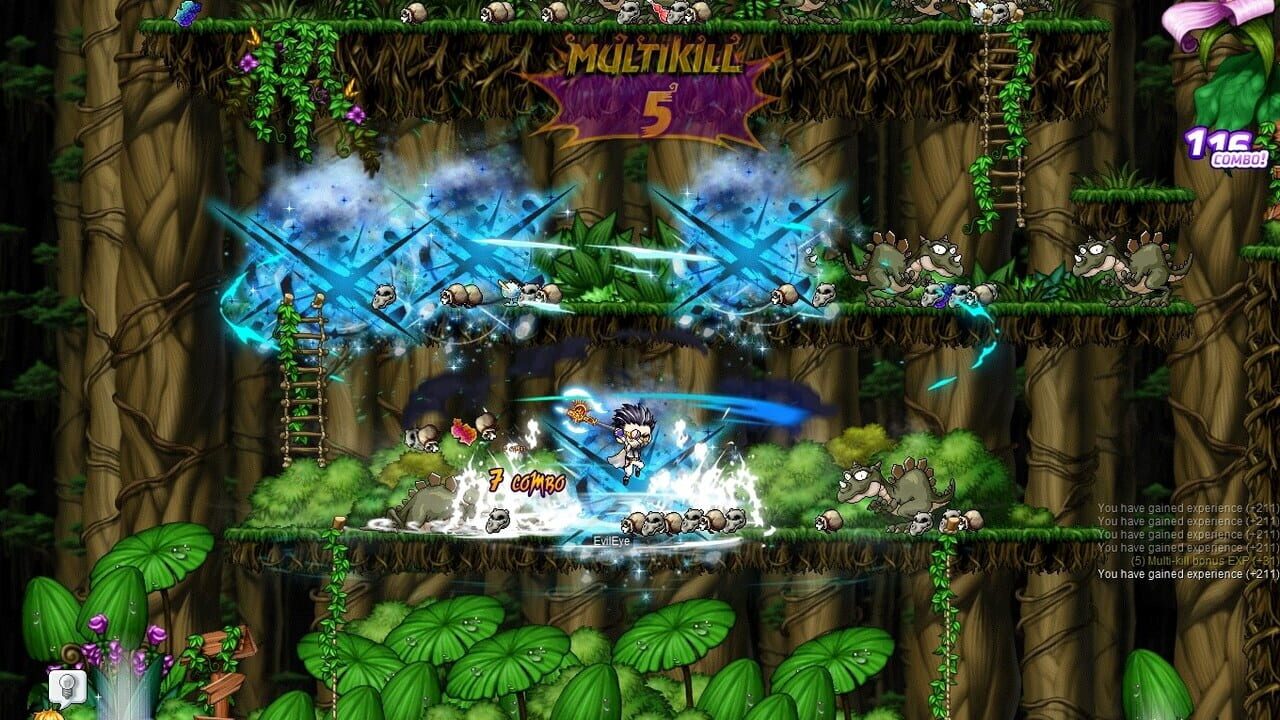
MapleStory
Colorful 2D MMORPG with hundreds of classes and epic boss battles.
Open the Knowledge Base — the game's own numbers in plain EnglishVerified November 7, 2026. MapleStory is a 2D side-scrolling MMORPG by Wizet and Nexon where you level your class across side-scrolling zones, hunt bosses, and clear endless repeatable content, with 50+ playable classes. This knowledge base compiles MapleStory's core rules — the class families, how job advancement works, how gear and currency function, and the boss-hunting loop that defines endgame — into plain English you can actually read. Everything here is the game's own structure and numbers; where a figure is server-specific or moves with a content update, it says so and points you in-game.
These are the game's own rules and systems — not live server data. For the current level cap, cash-shop contents, drop rates or any event-specific number, check in-game.
The game in one minute
What MapleStory is, at a glance
A 2D side-scrolling MMORPG by Nexon, run on a job-advancement model: you pick a starting family, reach your first job, then branch and advance through up to six tiers.
MapleStory is a free-to-play, 2D side-scrolling MMORPG. You create a character, pick one of the starting families, and move through a chain of job advancements — each tier unlocks a new skill set and reshapes how you play. The early roster ran on four Explorer families; the modern roster adds the Pirate lines, the Cygnus Knights, the Resistance, and a large set of standalone characters, for 40+ jobs in total.
Classes & families
The class families, from the original four to the modern roster
Progression begins with one of the five classic families. The original Explorers split into job branches at each advancement; the later families and standalone characters round out the 40+ jobs.
| Family | First-job branches | Role |
|---|---|---|
| Warrior | Crusader · Dark Knight · White Knight | Melee — frontline damage, tanks and support |
| Mage | Ice/Lightning · Fire/Poison · Priest | Ranged magic — damage, control and healing |
| Thief | Rogue · Assassin | Melee — fast, close, high-tempo |
| Bowman | Hunter · Crossbowman | Ranged — fast physical projectile damage |
| Pirate | Brawler · Gunslinger · Cannoneer | Close-to-mid — heavy physical and cannon support |
Beyond these, the game added three more families — the Cygnus Knights (Blaze, Thunder, Dawn, Wind, Night and Mihile), the Resistance (Xenon, Demon Slayer, Demon Avenger, Mechanic, Battle Mage, Wild Hunter and Blaster) — plus a long set of standalone characters (Mercedes, Aran, Phantom, Luminous, Evan, Shade, Kanna, Hayato and more). Together that's the 40+ jobs you can play today; the five families above are the ones a new account starts from.
Each family and system, on its own page
Job advancement
How a character advances through the jobs
Every tier unlocks a new batch of skills and a stronger build. The chain runs from your first job at level 10 up to the 6th-job tier, each step gated by a level and a quest.
| Tier | Rough gate | What unlocks |
|---|---|---|
| 1st job | Level 10 | Picks your family's first branch and its first skill set. |
| 2nd job | Level 30 | Splits into the second specialization. |
| 3rd job | Level ~70 (varies by family) | The classic endgame specialization of most families. |
| 4th / 5th job | High content (190–260) | High-capability endgame tiers. |
| 6th job | High-cap content | The newest tier; availability varies by server — check in-game. |
The job chain is the spine of the game's progression: damage and utility scale with each tier, and your late-game identity is set by which branch you commit to. The 3rd job is the classic specialization for most Explorers; the 4th through 6th tiers open the high-end build options, gear and stat systems that make endgame play.
Read the full job-advancement flow on its own page→Gear & progression items
Equipment, cubing and the Vellum / Maple Orchard loop
Power in MapleStory stacks through equipment slots, stone and option rolls, and a cubing mechanic that multiplies a base stat. The Vellum and the Maple Orchard are the long-term gear sinks players farm for.
Gear fills a fixed set of slots — weapon, armor, gloves, boots, cap, shield, plus ring, necklace, earrings and the newer 'potential' slot. Higher tiers introduce cubing: you roll a set of upgrade dice that multiply a piece's stat, with a success rate that improves as you bank more dice. Push further and the risk grows — the reward is a big stat jump, the downside is the roll can break the item.
The Vellum and the Maple Orchard sit on top of gear: they hold upgrade materials you bank and spend to cube equipment and to power late-game stat bonuses. That loop — farm the materials, bank them, cube the gear — is the long-game grind most dedicated players run, and it's what turns a well-leveled character into a powerful one.
Currencies & cash shop
Gold, NX and the cash shop
Two currencies run the economy: Gold, earned in-game and traded between players, and NX, a real-money currency that opens the shop.
| Currency | How you get it | What it buys |
|---|---|---|
| Gold | Loot, selling items, player-to-player trades | NPC gear, services, items and the market — the core in-game economy |
| NX | Purchased with real money | The cash shop — convenience items, cosmetics, event currency and some power items |
The cash shop is the real-money layer over the free-to-play core: it sells mostly quality-of-life and cosmetic items, plus some power items and limited event currency. You can clear the whole game without spending a cent, but the shop speeds up convenience and collection goals for the players who do.
Endgame — boss hunting
The boss loop that defines high-level play
Above the early content, the goal becomes named bosses — Zakum first, then Ursus, Papulatus, Gollux and the rest of the ladder, and the modern elite encounters — where a party or legion coordinates timing and gear.
The named-boss ladder (early → late)
- Zakum — the first 'big' boss and a rite of passage
- Ursus — an early high-level boss
- Papulatus — the first true late-midgame boss
- Gollux / Grendel / Gwyn / Tross — the second-generation named bosses
- Chaos (Root Abyss) — a landmark endgame encounter
- Modern elite & event bosses — confirm the current roster in-game
Boss hunting is where gear and cubing converge: clear the boss on a timed party, farm its drops and reward currency, cube your gear, then return. Legion content adds a second, recurring weekly boss loop on top of the named-boss ladder.
Read about Zakum — the first major boss — on its own page→The game's own numbers, in plain English — start from the Knowledge Base →
 Editorial
MapleStory How to Get Arcane Symbol Complete Guide
Master the MapleStory Arcane River with our complete guide covering Arcane Symbol acquisition, upgrade paths, and daily quest optimization.
 Editorial
MapleStory Legion Guide Optimal Board Setup 2026
Build the optimal MapleStory Legion board with our complete 2026 guide covering block placement, stat priorities, and Legion power optimization.
 Editorial
MapleStory 6th Job: Bishop HEXA Matrix Optimization Guide
Master the Bishop 6th Job HEXA matrix in MapleStory. Optimize your Sol Erda usage, prioritize Angel Ray vs Benediction, and find the best Carcion farming s…
Loading news...
Free Tools — MapleStory
Calculators, checkers and planners for MapleStory — free, no login. The rules behind every one live in the Knowledge Base →
MapleStory is a 2D side-scrolling massively multiplayer online role-playing game developed by Nexon. The game features colorful graphics, hundreds of classes, and extensive boss fights.