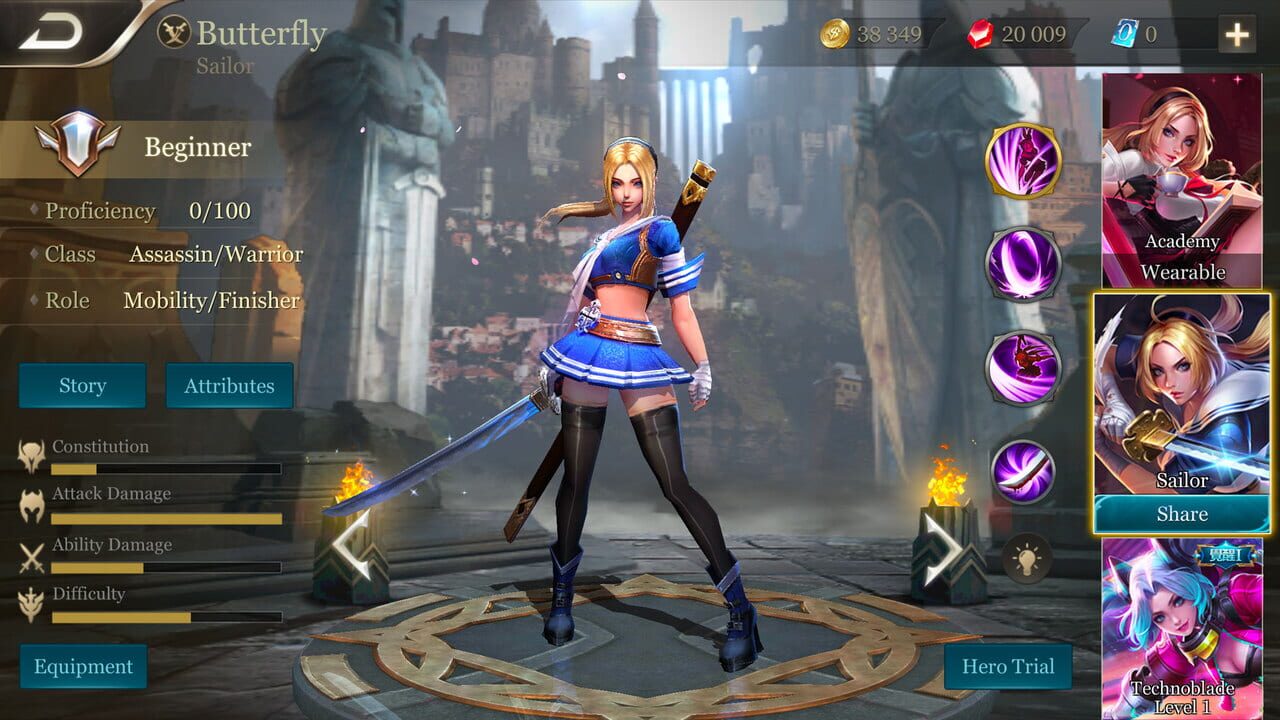
Arena of Valor is Supercell’s mobile-first MOBA: five players per team, three lanes, a central jungle, and a race to destroy the enemy’s core. It runs on short matches and a deep hero pool, which makes it forgiving for new players but punishing for players who ignore fundamentals. This guide focuses on what actually wins games so you stop blaming your teammates and start playing better.
Understanding the map and objectives
The map has three lanes: top, middle, and bottom. Your lane’s objective is to push the wave, take the enemy turret, and either rotate to another lane or join the fight at the center. The central river houses the Dragon (or the game’s equivalent major objective), which grants a team buff that makes teamfights easier. At later stages, an Elder Dragon spawns and a kill on it is usually the match-ending swing. Learn to check the minimap every few seconds; most lost fights start with a lane getting caught with no vision.
The lane wave is the core mechanic: the minions push toward the enemy turret, and your job is to last-hit them for gold and keep the wave in a position where you can push when the enemy is not around. If the enemy is pushing the wave and you are not, you are losing the lane by inaction. The wave position is more important than your own position: a wave that is deep in your tower means you are under siege and cannot push. Freeze the wave when you are winning; push it when you are losing and the enemy is not around.
Roles and where to start
Pick one role and commit to it for your first few dozen games. Common roles:
- Top: Usually a tank or bruiser who can hold lane solo and split-pushing.
- Mid: Mage or assassin who roams and controls the middle of the map.
- Jungle: Ranged or melee jungler who sets up early objectives.
- Bottom (bot): Marksman who carries late-game damage but is helpless early.
- Support: Enchanter who protects the bot lane and sets up vision.
As a beginner, top or support are the most forgiving because you are not expected to carry the game by yourself. Mid and bot are where new players feel the most pressure. The jungle role is the most mechanically demanding: you need to clear the jungle camps, set up ganks, and track the enemy jungle. If you want to learn the game deeply, jungle is the role that will teach you the most. If you want to learn the game quickly, top or support are the fastest path.
The role you pick also shapes the heroes you play. A top player picks tanks and bruisers; a mid player picks mages and assassins; a jungle player picks a mix of both. Learn the hero pool for your role before you try to hop between roles; the hero kits are role-specific and the skill ceiling is different for each one.
Lane fundamentals
Lane is 80 percent of the game. The core loop: last-hit the minions for gold, keep your health above a safe threshold, push the wave when the enemy is on the other side of the map, and call for a jungle gank when you have a health advantage. Do not chase an enemy into the river you cannot see. If you are losing lane, freeze the wave and play safe rather than forcing a trade you cannot win. Check in-game for current hero patch notes; Supercell updates heroes regularly and the meta shifts every few weeks.
Itemization and the gold economy
Gold is everything. Early items matter: a bot laner who falls behind on their first critical item will not catch up for the rest of the game. Learn the recommended build order for your hero from the in-game guide, then adapt based on the enemy composition. If the enemy has burst damage, buy defensive items early. If they have sustained damage, build sustain. Do not go in with the default build every time; the item page is a suggestion, not a law.
The gold economy is the meta-layer of the game. You earn gold from minions, kills, and objectives, and you spend it on items that shape how your hero plays. The item build is where the build depth lives: a hero who is built for burst plays differently from one who is built for sustained damage. As a beginner, learn the standard build for your hero and then adapt it to the enemy composition. The in-game item guide is the starting point; the community build guides are the optimization layer.
Teamfight discipline
Teamfights are won by positioning, not by who has the best hero. Stay in the backline for bot and mid, engage from the front for top and jungle, and use crowd control on the enemy carries first. If you die in a teamfight, your respawn timer means your team is fighting with four heroes while the enemy has five. The gold loss from a death snowballs. Before you engage, ask: do we have enough crowd control? Is the enemy bot alive? Is the Dragon up?
Rank mode and mindset
Rank mode uses a queue system that groups you with similar skill. Your first few ranked games are a skill check; do not tilt. Track your own mistakes in the post-game summary: deaths, missed objective control, and unnecessary deaths are the three stats that matter. If you lose five games in a row, stop. The system will not fix your game for you.
FAQ
What is the best hero to start with in Arena of Valor?
Pick a hero who is simple and strong in your role. A top tank with an easy kit beats a complex assassin you have not practiced. The in-game hero guide and the current meta patch notes will tell you which heroes are performing well right now. Focus on the hero’s core mechanic: the one ability that defines the play style. If you understand that mechanic, you understand the hero.
How do I win if my teammates are not communicating?
Play your role and force the game to be won by objectives. If your team is not playing together, take the map: push lanes, take turrets, and make the enemy respond to you. You cannot carry a dead team, but you can make the game easier for the one or two players who are trying. Track your own objectives in the post-game summary: if you are taking objectives and the team is not, that is the stat to fix.
Is Arena of Valor free-to-play?
Yes. The game is free on mobile and PC. Heroes are unlocked through gameplay currency; cosmetics and convenience items are the paid layer. No hero is pay-to-win. The hero unlock system is the main paid layer: you can unlock every hero through gameplay currency, but the premium cosmetics and the convenience items are the optional spend.
How do I practice the mechanics without playing ranked?
Use the training grounds or the custom game modes. The training grounds are where you practice the dodge windows, the aim tracking, and the item builds. The custom game modes let you play with friends without the pressure of the ranked ladder. The ranked ladder is where you test your skills, not where you learn them.
Keep exploring
- Arena of Valor on MMOKB — the Arena of Valor game hub has the full knowledge base, tools and guides.
- Browse the full library — all MMOKB guides
Reviewed & verified
| Covers | Arena of Valor |
| Last verified | November 24, 2026 |
| Accuracy | The game’s own numbers and rules — they change with patches; check in-game for live values. |
Discussion
0 commentsNo comments yet. Be the first!