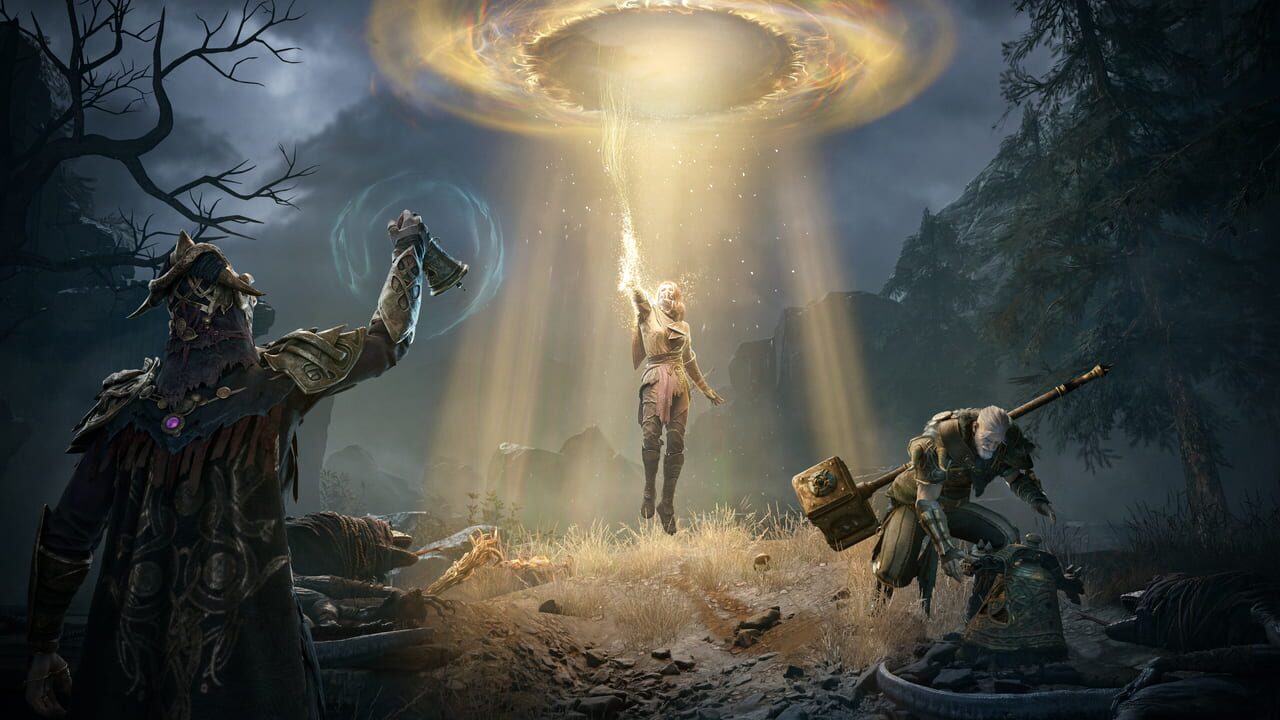
The single most confusing thing about Mistfall Hunter is that your class doesn’t define your skills — your weapon does. Players coming from Diablo, soulslikes, or Dark and Darker keep asking why their hotbar changed after a loot swap. This guide explains the full build chain — Class → Weapon → Skills → Talents → Holy Weapon → Affixes — and lists every class’s weapon options so you can stop guessing.
The Build Chain, Explained
Most RPGs run Class → Skills → Gear. Mistfall Hunter runs deeper:
- Class sets your base identity and role.
- Weapon determines your active skills — each stance carries its own separate set.
- Talents reshape how those skills behave.
- Holy Weapons add exclusive gameplay affixes that change your rotation.
- Affixes on gear tune the numbers.
The practical consequence: a Mercenary holding a Hammer has zero Sword & Shield skills on their bar until they swap back. Swap your stance and roughly half of your buttons change with it.
Why Your Skills Changed Mid-Dungeon
This is the number one new-player question. The answer: every class carries two separate weapon categories and can swap between them mid-combat. Each weapon has its own:
- Active skills
- Combo routes
- Talent priorities
- Build identity
What swapping does not change: your class, your progression, your core role.
So the right mental model isn’t “I picked Mercenary” — it’s “I picked Hammer” or “I picked Sword & Shield.” Your class is a pair of fighting styles, not a fixed kit.
Every Class and Its Weapon Stances
Not every class launched with both stances live. Here’s the full weapon map:
| Class | Weapons | Best For |
|---|---|---|
| Mercenary | Sword & Shield / Hammer | Beginners, blocking, frontline defense vs heavy burst |
| Shadowstrix | Dagger / Dual Blades | Solo play, PvP ambushes, high mobility |
| Seer | Catalyst / Mace | Team support, healing, debuff pressure — cannot swap mid-fight |
| Withered Knight | Greatsword / Polearm & Shield | Heavy damage, timing-based frontline play |
| Sorcerer | Staff (only) | Ranged damage, area control; second weapon in development |
| Blackarrow | Bow (only) | Scouting, ranged pressure, debuff stacking; Javelin planned for a future season |
Two special cases worth flagging:
- The Seer’s weapon choice is tied to its faith path — you commit at character level, not run-by-run.
- Launch-era Sorcerer and Blackarrow have only one weapon, which makes their build trees narrower but their mastery curves faster.
Active Skills vs Derived Skills
Your skill screen showing “24 entries” does not mean 24 usable slots. Derived skills — follow-ups, counters, air strikes, post-dodge hits — have their own entries but take no bar slots. They chain from your active skills automatically. When planning a build, count only the active slots; the derived layer is your combo ceiling, not your shopping list.
Holy Weapons: The Endgame Build Layer
Holy Weapons are a new tier dropped by map bosses, each with a unique drop source. They matter because they carry exclusive gameplay affixes — not stat inflation, but behavior changes:
- They change your rotation.
- They create build possibilities that don’t exist without them.
- They’re treated as endgame progression in their own right.
Think of a Holy Weapon as another build layer on top of your stance, not just a bigger number. Two players with identical classes, stances, and talents can end up with genuinely different characters because of their Holy Weapons.
The Affix Layer: Where Numbers Actually Come From
Below Holy Weapons sits the affix system on your regular gear — and it’s the layer most players undervalue. Affix priorities differ by stance, and the differences are large enough that a “wrong” affix build underperforms a “right” one by a full tier:
- Defensive stances (Sword & Shield, Polearm & Shield) scale hardest with block-rate, guard-efficiency, and post-block counter affixes — the 100% block Mercenary builds that dominated beta were affix constructions, not talent miracles.
- Burst stances (Hammer, Greatsword, Dagger) want critical, backside, and combo-completion affixes — anything that feeds the derived-skill layer.
- Ranged stances (Bow, Staff) prioritize cast-speed and AoE-footprint affixes over raw damage percentages, because their damage model is uptime-based.
The practical rule: read your stance’s derived skills before shopping affixes, because the affixes that feed follow-up chains outvalue flat damage at every tier below endgame. Affixes plus Victory Wine buffs are also the cheapest power you’ll ever buy — a complete affix pass on cheap gear beats a single expensive upgrade every time.
The Five Build Mistakes Nearly Everyone Makes
- Swapping stances constantly without mastering either. Master one weapon first, then add stance swapping. Weapon-specific talents provide stronger early power than split investment.
- Thinking in classes instead of weapons. Build around the stance you actually use 80% of the time.
- Chasing raw item level over Holy Weapon effects. The affix layer out-values small stat differences.
- Spreading talent points across both stances early. Concentrated talents beat diversified ones until endgame.
- Ignoring derived skills when learning combos. Your real damage comes from the chained layer, not the bar.
Recommended Progression Path
- Pick a class whose two stances both appeal to you (Mercenary and Shadowstrix are the most flexible; Sorcerer/Blackarrow are one-stance commitments).
- Choose your main weapon and spend your first talents there exclusively.
- Learn its combo routes including derived skills until they’re muscle memory.
- Add stance swapping only after your first weapon feels automatic.
- Start hunting map bosses for Holy Weapons once your affix base is solid.
The build system looks intimidating, but it rewards the same thing every extraction game rewards: commitment to one tool until it’s second nature. Master a stance, then break the rules with Holy Weapon effects.
Ready for Season 1 content? Our Soul Harvest event guide covers the ritual mechanics these builds were made for, and the extraction risk-versus-reward guide covers when to walk away.
Discussion
0 commentsNo comments yet. Be the first!